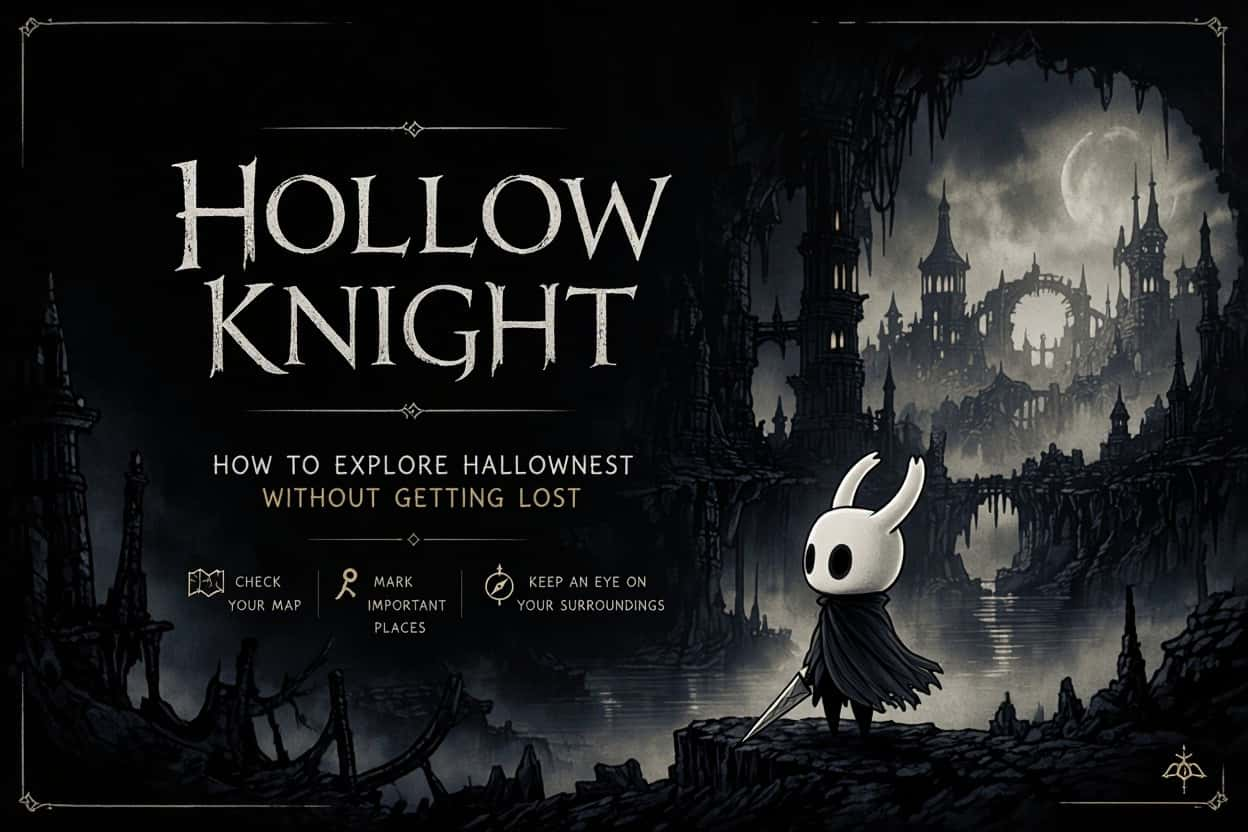
Hallownest is designed to make players feel uncertain. Its interconnected tunnels, hidden passages, vertical chambers, and unfamiliar landmarks create a world that is difficult to understand at first. Unlike games that constantly display objective markers, Hollow Knight expects players to observe their surroundings and gradually build their own mental map.
Getting lost is part of the experience, but repeated backtracking can become frustrating when players do not understand how the map system works. A few practical habits make exploration considerably more efficient.
Understand How the Map System Works
Hollow Knight does not automatically reveal every room when entering a new area. Players need to purchase maps from Cornifer, the cartographer, who can usually be located by following his humming and looking for scattered sheets of paper.
Finding him should be a priority whenever entering an unfamiliar region.
After purchasing a map, the area becomes much easier to navigate, but it is still incomplete. The map does not necessarily show every secret passage, hidden room, or important landmark.
The Quill is especially useful because it allows newly explored sections to be added to the map when resting at a bench.
This creates a simple exploration cycle:
- Enter a new region and look for Cornifer.
- Purchase the regional map when available.
- Explore a manageable section of the area.
- Return to a bench to update the map.
- Mark important discoveries mentally or through the map system.
Use Benches as Exploration Checkpoints
Benches are more than places to restore health. They are strategic checkpoints that influence how safely you can explore.
Resting at a bench updates your position and provides an opportunity to reorganize your exploration plans. It also makes newly discovered routes easier to understand.
Before moving deeper into an unfamiliar region, identify the nearest bench whenever possible.
This is especially important in areas containing difficult platforming sections or enemies that deal significant damage.
A useful rule is to avoid continuing deep into an unknown area when your health is low and you have no clear route back.
Recognize Landmarks Instead of Memorizing Every Corridor
Hallownest contains many rooms that look similar at first glance. Memorizing every turn is inefficient, particularly in large regions.
Instead, pay attention to recognizable environmental features.
Look for:
- Distinctive statues and architectural structures.
- Large vertical shafts connecting multiple levels.
- Elevators and mechanical platforms.
- Unusual lighting or background colors.
- Doors that require special abilities.
- Benches, stag stations, and other permanent landmarks.
These features provide a more useful mental picture than remembering a long sequence of left and right turns.
When returning to an earlier area, try navigating between recognizable landmarks rather than retracing every movement exactly.
Understand How Abilities Change Exploration
Progress in Hollow Knight is closely connected to movement abilities.
Some routes cannot be reached until the Knight gains the appropriate ability. Attempting to access every visible platform immediately can waste considerable time.
Important movement upgrades include:
| Ability | Exploration Benefit |
|---|---|
| Mothwing Cloak | Enables horizontal dashes |
| Mantis Claw | Allows wall climbing and wall jumping |
| Crystal Heart | Enables long-distance horizontal movement |
| Monarch Wings | Provides a double jump |
| Isma’s Tear | Allows movement through acid |
When encountering an apparently inaccessible route, consider whether it requires a later ability instead of repeatedly attempting the same jump.
This approach reduces unnecessary backtracking.
It also changes how players interpret the environment. A blocked passage is not always a challenge that must be solved immediately; sometimes it is simply a reminder to return later.
Use Short Exploration Loops
One of the most effective ways to explore Hallownest is to work in small loops.
Rather than moving through an entire region without stopping, choose a limited objective. This might involve finding a bench, locating a shop, discovering an ability, or opening a shortcut.
Once the objective is complete, return to a safe location and review the newly accessible routes.
Short loops are especially useful when:
- You are carrying a large amount of Geo.
- You have discovered several unexplored branches.
- A difficult enemy is blocking the main route.
- You are unsure whether a passage requires a new ability.
- You need to update your map.
Opening shortcuts is particularly valuable. A gate or elevator that connects two previously distant areas can save more time than discovering several optional rooms.
Spend Geo Carefully
Geo is required for maps, charms, upgrades, and other purchases. Losing a large amount of it after an unsuccessful exploration attempt can be discouraging.
Avoid carrying unnecessary amounts of Geo when entering unfamiliar or dangerous sections.
When you have enough money for an important purchase, consider returning to the relevant shop rather than continuing to accumulate currency.
The goal is not to avoid every dangerous encounter. It is to make exploration financially manageable.
Exploration Is More Efficient When Curiosity Has Direction
Hollow Knight rewards curiosity, but random wandering is not always productive.
A useful strategy is to maintain three priorities:
- Immediate objective: Reach the next bench or unlock a shortcut.
- Progress objective: Find a new ability, important character, or major route.
- Optional objective: Investigate suspicious walls, hidden rooms, and unexplored branches.
This distinction helps prevent optional discoveries from distracting you from essential progression.
Hallownest is deliberately interconnected, and its layout becomes easier to understand as more shortcuts and movement abilities become available.
Once you stop treating every unexplored corridor as an urgent task, the world becomes far less confusing. Exploration starts to feel like solving a large interconnected puzzle rather than wandering through a maze without direction.
About the Author